Wednesday, August 15, 2012

52/100: Gone Girl

So school's starting again on Monday (boo).  And, depending on my reading list for Children's Library Materials, I should be able to make my goal of 100 books this year! I hope.  We all know reading-related disasters could happen at any time.

Anyways, I was reflecting tonight over the best book I read over the summer.  And, really, there was no contest for the winner:


Gone Girl by Gillian Flynn

Now, I don't normally read suspense--and indeed, when I had to read a suspense novel for class last semester I wasn't really impressed with the book I chose.  But this book piqued my interest for an entirely different reason: people kept letting it go overdue.  Most people are pretty on top of renewing their library materials, but for some reason, when I told people this book was overdue, they'd say "I know, but I just HAVE to finish it."

Okay, I thought.  This book must be good if people are willing to pay fines to finish it.

So, without knowing anything about the book (I mean, I hadn't even read the synopsis on the jacket), I decided to put it on reserve.  But then I saw there were like 190 reserves on it so I said screw it and decided to wait.

But then! As if the library gods knew, it came through as a donation.  When I saw it on our for sale shelf the next day, I snapped it up.  If it's worth 10 cents a day to read, surely it was worth $3 to own?

OH MAN YES IT WAS.

This book is MESSED UP.  I mean, REALLY MESSED UP.

The story takes place in a fictional town in Missouri, along the Mississippi River.  It follows two people, Amy and Nick Dunne, who are facing some rough waters in the marriage.  On their 5th wedding anniversary, Amy goes missing.  The novel covers the investigation through the alternating perspectives of both Amy and Nick.  I can't really say a whole lot without giving things away.

The main point here is that this book is not what it seems.  And Gillian Flynn does an amazing job at drawing you in.  The book is divided into three parts.  In part one, everything seems pretty status quo for a suspense novel, but something is not quite right about it. You can't really put a finger on why things are off, but you know there's more to this story.  And then part two starts, and I swear to God, I have seriously never hated a fictional character so much in my LIFE.  Every time I turned the page, all I could say was "I hate this person.  I really fucking hate them." And then your rush through part 3 because HOLY CRAP YOU CAN'T BELIEVE THESE THINGS ARE HAPPENING.  You really can't believe the horrible things characters do to each other.

And the whole story is just...disturbing (but in a good-literature sort of way).  After I finished the book I felt the need to put it down and physically walk away from the book.  I was SO unsettled.  Almost in the same way I was mega-depressed after I finished The Bell Jar.  You know, the good kind of literature-empathy, as it were.

As awesome as this book was, though, I have two small complaints.  And these are mostly due to the fact that I grew up in Missouri.
1) Although Flynn uses a fictional town in Missouri, the location she is describing is geographically impossible.  North Carthage (the town in the book) is where Nick grew up, and it's described as being close enough to Hannibal so that Nick could have worked there as a kid, but no more than 45 minutes from St. Louis.  There is no location in Missouri--that borders the Mississippi--in which you are, at most, 30 minutes from Hannibal and 45 minutes from St. Louis.  St. Louis and Hannibal are 2 hours apart.
2) As you are driving towards St. Louis (as Nick does), the Arch does not "creep up the skyline." It is WAY downtown, and therefore you literally don't see it until you are in downtown and it peeks around a building.  (Now, coming from the Illinois side is a different story).

BUT THOSE THINGS ASIDE, this was truly an awesome book.  Totally recommend it, especially now that they're turning it into a movie.  Be ahead of the curve!

Tuesday, June 19, 2012

Heather Brewer

So tonight I went to the book launch party of Heather Brewer's new book, Soulbound. Now, I'll admit, I've never read a Heather Brewer book before.

I know. It's weird. Why would I go to a book signing for an author I've never read? Well, there were several reasons.

1) I LOVE author events. They have such great energy. As a writer, nothing gets me more motivated to write than to see another author talking about their work. And hearing someone read their own stuff? There's nothing like it. And lately, I've been running low on inspiration in the writing department, so I thought I might as well go to get myself inspired.

2) I'd heard good things about Heather Brewer's books in my Teen Library Materials class, and the last event she did at the library was apparently a great time had by all.

3) I have so very little in my life besides work. Sad but true.

4) Her new book totally sounds like something I'd read, so I was all over that. MOAR YA!!!

Now, the thing about going to a book signing for a YA and/or children's author when you're my age is that you have to be prepared to be the only person from your generation there. No really. The last two YA events I've gone to, I was the oldest person there who didn't have kids. It's basically a bunch of 10-15 year olds, ME, and then all the moms. Yes, I DID feel like a huge creeper, thanks for asking! It doesn't bother me enough to stop going, obviously, but still.


Anyways, I am so glad that I went. I've been to a few author events before and I've always enjoyed them greatly. But Heather Brewer...she's good. She writes YA, but she skews a little young (11-14). And any YA author, when they're talking to kids, won't talk down to them. They talk to kids like their feelings, opinions, and dreams are just as valid and important as any adults'. Which they are, but a lot of times teens aren't given a lot of credit for the depth they can possess.

But I don't know, something about the way she spoke was just...so utterly sincere. Like she really, honestly cared deeply for each and every person who came out to see her. And she was honest (particularly when she revealed her true feelings about Twilight. Haha). She was just so genuine, and I was really touched by that. Not that the other authors I've seen haven't been genuine, but none have been as....earnest as Heather Brewer. It was like she had this deep-seated respect for her readers, and that respect was something she cherished.

So I know I'm heading into sappy territory here, but the whole thing was such a positive experience for me. And of course, it did motivate me to write. What about, I don't know, but as Heather said, butt+chair=book.


Saturday, June 2, 2012

Strong vs. Strong Female

I think a lot of people think Katniss Everdeen is a strong female character when in fact she's just a strong character.

"What's so important about the word female?" you ask. Well, a lot.

I think a lot of people are confusing being a "strong female character" with denying ALL aspects of the female sex. Think Lady MacBeth. But Lady MacBeth is huge bitch. The fact that she denies her sex is NOT A GOOD THING. I mean, going around and saying "out, damn spot" is not exactly healthy behavior.

And that's where Katniss comes in. She's a FEMALE and a TEENAGER and she doesn't act like it. I understand that she's compartmentalizing and she's been through a trauma and blah blah blah, but that's simply unrealistic. Look, I've met more than a few refugees. People who have witnessed and lived through unspeakable trauma. And you know what? Yes, they are more aware of the gravity of society than most people. But they still act their age.

Which is something Katniss does not do.

I feel like Katniss's characterization relies heavily on "well, she's been through trauma."  Which sure, is a good way to START characterizing someone, but to completely center someone's personality on trauma? It's just as flat as characterizing someone based on their relationship to another person (I think we all know what book I'm talking about here).

What does it say that we think a strong female character has to not act like a girl? In the same way I wouldn't want anyone to emulate Bella Swan, I wouldn't want anybody emulating Katniss, because she's too detached from her emotions.

I want my strong female characters to act like strong females. Not genderless or emotionless, which Katniss is. People value connection, and Katniss doesn't. I don't think we should extoll the virtue of someone who doesn't care about others out of anything other than obligation.

I guess my point here is that I feel that Katniss could have been a boy and it would have been the same story.  And that's not a strong female character.  It's just a strong character--which is fine, and it is something we need in literature (especially for teenage boys, who often feel alienated from female-protagonist YA lit because it "doesn't relate to them.") But I feel that in the steps people take to avoid gender stereotypes, they forget that it's okay to be proud of your gender.  You don't have to create gender neutrality in order to have a strong character.

Basically: it's okay to love your vagina.  They wrote a play about it.


A caveat here: A lot of the arguments I hear about Katniss being a strong female character rely heavily on the fact that "she's not interested in a romantic relationship." I want to be clear that I personally do not equate being a strong female character with having a romantic relationship.  There are plenty of ways to express being a strong female, and most of them have nothing to do with romance.  But in the following argument, I do talk a lot about romance simply because in the arguments about strong female characters, romance is cited quite a bit (eg, Bella is a weak character because she is too into Edward; Katniss is a strong character because she doesn't think about boys).  And I think that there is a relationship component to the whole strong female character thing.  That relationship is not necessarily romantic, but it often manifests as one.


So now I guess you're wondering: who do I consider a strong female character?  There's a great book series called Across the Universe by Beth Revis.  It's often used as a read-alike for The Hunger Games as well.  Across the Universe tells the story of Amy and Elder, two residents on the ship Godspeed.  Elder is one of the leaders of the ship; Amy is a passenger from Earth who has been in suspended animation for 300 years.  The plot revolves around uncovering the secrets aboard Godspeed and making decisions about what is "best" for a society (it's also unique in that it's one of the few dystopias that really makes you understand why society got to such a point, and how leaders decide what to do next).

While the story itself is fascinating, Amy is what really makes the series for me.  Amy acts like a teenage girl, which, in my opinion, is something you don't see in a lot of dystopias these days.  Amy struggles with her emotions like a 17-year-old would.  She thinks critically about her relationship with Elder: does she truly like him, or does she like him because he's the only thing available? I realize that it could be argued that Katniss has a similar struggle, but I feel like the closest Katniss gets to thinking about it is "Does he? Well, I'll think about that later."  And even then, I don't feel any EMOTION there.  But when Amy and Elder need to put aside their relationship so they can focus on the ship, they do.  They can be serious, but they can also be teenagers.

And that's what makes Amy a strong female character.  That's she's confident in herself, and she consider her own feelings.  She acts like a girl, and is proud of being a girl.  She recognizes the risks of being a woman on Godspeed (the society is, in theory, egalitarian, with a notable exception that makes Amy vulnerable), and addresses them without denying her sexuality.  Which is something Katniss does not do.

Both Katniss and Amy have to compartmentalize in order to survive.  Katniss does it to become dead inside, and I struggle to accept a protagonist who is so distanced from her emotions.  Being strong doesn't mean denying your emotions.

I think the popularity of Katniss stems at least in part from the backlash against Bella Swan and Twilight.  Bella is so ruled by emotions that she becomes weak.  Some readers see Katniss and think: she's so good at controlling her emotions, she must be strong!  She's so unlike Bella! Which is true, of course, but just because she isn't consumed by emotions doesn't make her better than Bella.  If anything, Katniss is consumed by her lack of emotion.

This is why characters like Amy get lost in the mire.  Like Katniss, Amy must compartmentalize, but instead of negating her emotions, Amy channels them into her cause.  Her emotions are realistic, and sadly, in the world of YA, this is what causes her to become lost.  She's not emotional enough for fans of Bella, but she's too emotional for fans of Katniss.

There needs to be a middle ground.  It's the characters like Amy, the ones who forge and exist in that middle ground, that are the strongest female characters of all.

Saturday, May 26, 2012

Ash by Malinda Lo

I just finished Ash by Malinda Lo. It's a lesbian retelling of Cinderella. Which is a cool concept. But it's a bit of surprise!lesbianism, which is something I don't really enjoy.  I'm not a fan of any sort of surprise!relationship in a book, no matter where on the spectrum of sexuality it falls.  It doesn't matter who's falling in love with whom, I need to know WHY these people are falling in love.

And in this book, I don't understand why Ash (the Cinderella character) loves Kaisa (who is basically the prince here). Quite literally, the moment of falling happens in one sentence. Ash doesn't even THINK about Kaisa that way until someone plants the idea in her head. The relationship between Ash and Sidhean (the fairy godfather in this story) is far better developed. It happens in a distanced, fairy tale sort of way, but you understand their attraction to one another. And the writing implies that the attraction is mutual.

The one thing this book had going for it was its views on sexuality. In this society, homosexuality was normalized--that is, nobody made a big deal if you liked people of the same gender. It was just another option. And it's implied (though somewhat unconsciously; it doesn't seem to be a very developed idea, as if Lo herself didn't know what she was talking about) that sexuality is a spectrum, not an either/or choice. It's quite clear that Ash has feelings for both Sidhean and Kaisa. Which is something that happens in real life.

However, Lo seems to completely ignore these ideas. Instead of recognizing that sexuality is not black and white; that you can have feelings for multiple genders, and that there are other definitions of sexuality between gay/straight/bi, Lo goes with a standard definition. Ash is a lesbian. That's all there is to it. That's how Lo views it. But the thing is, the text doesn't support that characterization. It's like Lo was trying to fit Ash into a box, and the fact of the matter is, she doesn't. And that's the way a lot of sexuality works: it doesn't fit neatly into a box. It's okay to have radical ideas about gender and sexuality. Just because it's a lesbian retelling doesn't automatically make it revolutionary or insightful. If the idea here is to normalize homosexuality (which I'm all for), then we should judge the book and the relationship itself on how well it is constructed. Which in this case is not good.

Without proper character development, this lesbian storyline comes off as a cheap trick. And what's more irritating is that Ash is completely helpless. Just because the main character is a lesbian doesn't mean the story is progressively feminist. What I mean is that Ash is saved by someone else, both a man and a woman. It doesn't matter that the twist is that she's saved from poverty by a woman; she still has to be saved. She still needs to be protected. How is that challenging prevailing ideologies about gender?

One thing we talked about a lot in my Teen Library Materials class (which is where I read this book) is the need for quality books about LGBT issues.  Serving LGBT youth is considered one of the critical needs of YA librarianship.  And that's why I had such high hopes for <i>Ash</i>.  It seemed like a book that had a higher level of understanding of the concepts of gender and sexuality.  But instead of going outside the box, Lo forces the story into a standard format, and the story completely falls apart. The lesbian aspect of this story comes off as a cheap trick, and I don't think anybody takes too kindly to a writer using a hook like that to draw in readers, especially when it can be such a touchy issue.

Wednesday, April 25, 2012

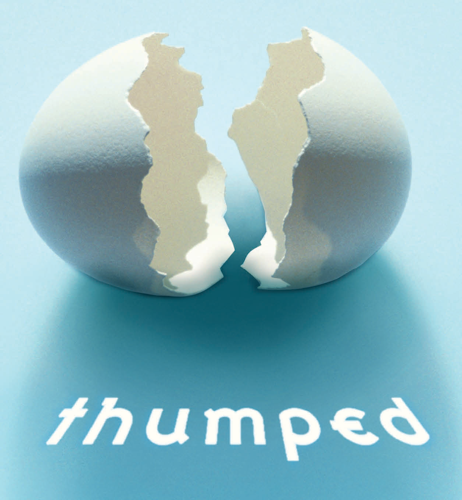
Thumped

*gasps for air*
Yes, yes, I'm still alive, I promise. And been doing lots of reading! I've just been buried under a mountain of schoolwork. And yes, while I should have finished the memoir I'm supposed to have read by tonight at 6, I decided to read something else:


Thumped by Megan McCafferty

I didn't realize it until just now, but the one other time I blew off end-of-semester work for a book was when Perfect Fifths (another Megan McCafferty book) came out. So it says a lot about my love for this woman.

So Thumped is the sequel to Bumped, which follows twin sisters, Melody and Harmony, in a world where a virus has made it such that most people become infertile by age 18. So, in order to keep the population up, teenagers are encouraged to get "bump" and "preg" for profit. Harmony was raised in a religious community called Goodside, where traditional values prevail, and Melody was raised to be millionaire pregger. When the two meet for the first time, both Melody and Harmony are forced to re-examine your value system.

While reading Thumped, I often felt uneasy, and I was unsure if I really liked the book or not. But once I realized that while it may be billed as a dystopia, it doesn't fit into that traditional category of YA dystopias. Oh sure, many of the same elements are there, but there's something very different about Thumped.

First, a random aside: the slang in this world is extremely well developed. While I love dystopias, I usually find the imaginary slang in them to be a bit forced. But the slang in this series is flows very naturally. It takes a few chapters to get used to, but once you do, it really adds to the setting rather than detracts from it like slang in other dystopias.

Now to the good stuff...
What separates Thumped from other dystopias is how closed in it feels. Chapters switch between Melody's and Harmony's point of view. And as things happen around them and they're confused by it all, so are we. The story is very personal: unlike a lot of dystopias, it's not focused on criticizing some aspect of our current society. True, the story was inspired by all the media attention the girls on 16 and Pregnant and Teen Mom were getting, but to say that teen pregnancy is glamorized in this country is an overstatement. Anyways, my point here is that Thumped is not some grand commentary about how depraved society has gotten. It's about what happens when people live in a world that is the completely opposite of what it was a generation ago. The Virus in the story is fairly new (less than 50 years old), so there are generations of people who still remember the way things used to be. Melody and Harmony are part of a generation who need to figure out their place in a changed world. So the story is not about taking down a Big Bad, merely changing the way people view the world. It's not about the end of a revolution, but the start of one. Society doesn't change totally overnight.

And what I love is that the ending of Thumped is somewhat ambiguous. I mean, you come away knowing that the characters have made the right choices and that certain things are going to change, but there hasn't been some magic cure to the Virus. Harmony still knows she's got a long way to go. Melody's not entirely sure what her life is going to be now. But that's okay. Because that's how life works. And there's still enough of a sense of newness about this world that you as the reader are satisfied because you know there's room to grow. There's optimism, and for such a personal story, optimism is enough.

Both Bumped and Thumped are quite different from a lot of YA dystopias out there. And that alone makes them worth the read.

Friday, January 6, 2012

Let's Try This Again, Shall We?

So last year was a bit of a bust, with me clocking in at only 39 books read. Okay, so it was a major bust, I'll admit that.

But I am ready and willing to try this bad boy again (this will now be my third try, but I really am taking that "if at first you don't succeed" adage to heart). Is part of my motivation the fact that I'm in two reader's advisory courses this spring and that means reading a LOT of books for class? Why yes, yes it is. I'll take motivation anywhere I can find it, thank you very much.

No rules this year. As long as it's a novel, it counts. Manga and comics count.

Let's do this.

2011 Totals

2011 Book List:
1. Mockingjay - Suzanne Collins
2. The Seer and the Sword - Victoria Hanley
3. The Healer's Keep - Victoria Hanley
4. Water for Elephants - Sara Gruen
5. Across the Universe - Beth Revis
6. Life After Genius - M. Ann Jacoby
7. Queen of Babble - Meg Cabot
8. The Goose Girl - Shannon Hale
9. The Weird Sisters - Eleanor Brown
10. Delirium - Lauren Oliver
11. The Crimson Thread - Suzanne Weyn
12. The Storyteller's Daughter - Cameron Dokey
13. The Diamond Secret - Suzanne Weyn
14. Matched - Ally Condie
15. Howl's Moving Castle - Diana Wynne Jones
16. House of Many Ways - Diana Wynne Jones
17. Bumped - Megan McCafferty
18. Jane - April Lindner
19. Divergent - Veronica Roth
20. Abandon - Meg Cabot
21. Smokin' Seventeen - Janet Evanovich
22. The Misted Cliffs - Catherine Asaro
23. Overbite - Meg Cabot
24. The Dawn Star - Catherine Asaro
25. The Fire Opal - Catherine Asaro
26. The Night Bird - Catherine Asaro
27. Eon: Dragoneye Reborn - Alison Goodman
28. Eona: The Last Dragoneye - Alison Goodman
29. The Last Little Blue Envelope - Maureen Johnson
30. The Invention of Hugo Cabret - Brian Selznick
31. Incredibly Alice - Phyllis Reynolds Naylor
32. Not Without My Daughter - Betty Mahmoody
33. Sisterhood Everlasting - Ann Brashares
34. Incarceron - Catherine Fisher
35. Goliath - Scott Westerfeld
36. Modelland - Tyra Banks
37. Explosive Eighteen - Janet Evanovich
38. Wonderstruck - Brian Selznick
39. Encore - Joan Lowery Nixon

Total: 39


Best Book: Sisterhood Everlasting
Although I do have to give a shoutout to Modelland. It was far and away the most...interesting thing I've ever read. In years. It was kind of like a mixture between Lord of the Rings, The Hunger Games, and Charlie and the Chocolate Factory. It certainly was quite a trip.

Worst Book: Jane. In 2011, there is no excuse for keeping your crazy wife locked up in the attic. None. Also: mahogany lined box of condoms. It actually happened.

Disappointing Books:It'd have to be a tie between Eona: The Last Dragoneye and Delirium. Bot had interesting story ideas that interested me, but they fell flat. Eona wasn't a bad book, but something happens to a character in the last 25 pages of the book that a) is completely contrary to the path they'd been on for the previous 600 pages and b) completely undermines the strength of the main character. Not to mention that it displays a relationship with SERIOUS trust issues as being "solid." Um, no. And Delirium makes the grade simply because a single editing error on page 16 completely undermined the theme of the book.

Book I Hated with a Fiery Passion: Mockingjay. Character assassination and discarding plot simply to get out an anti-war message. And the laziest writing I think I've EVER read. You don't have a character pass out THREE TIMES during separate but equally important plot points. Just abysmal.

So...erm...quite a bit short of the 100 goal. But I'm okay with that. I can always try again, and I plan to do just that.